
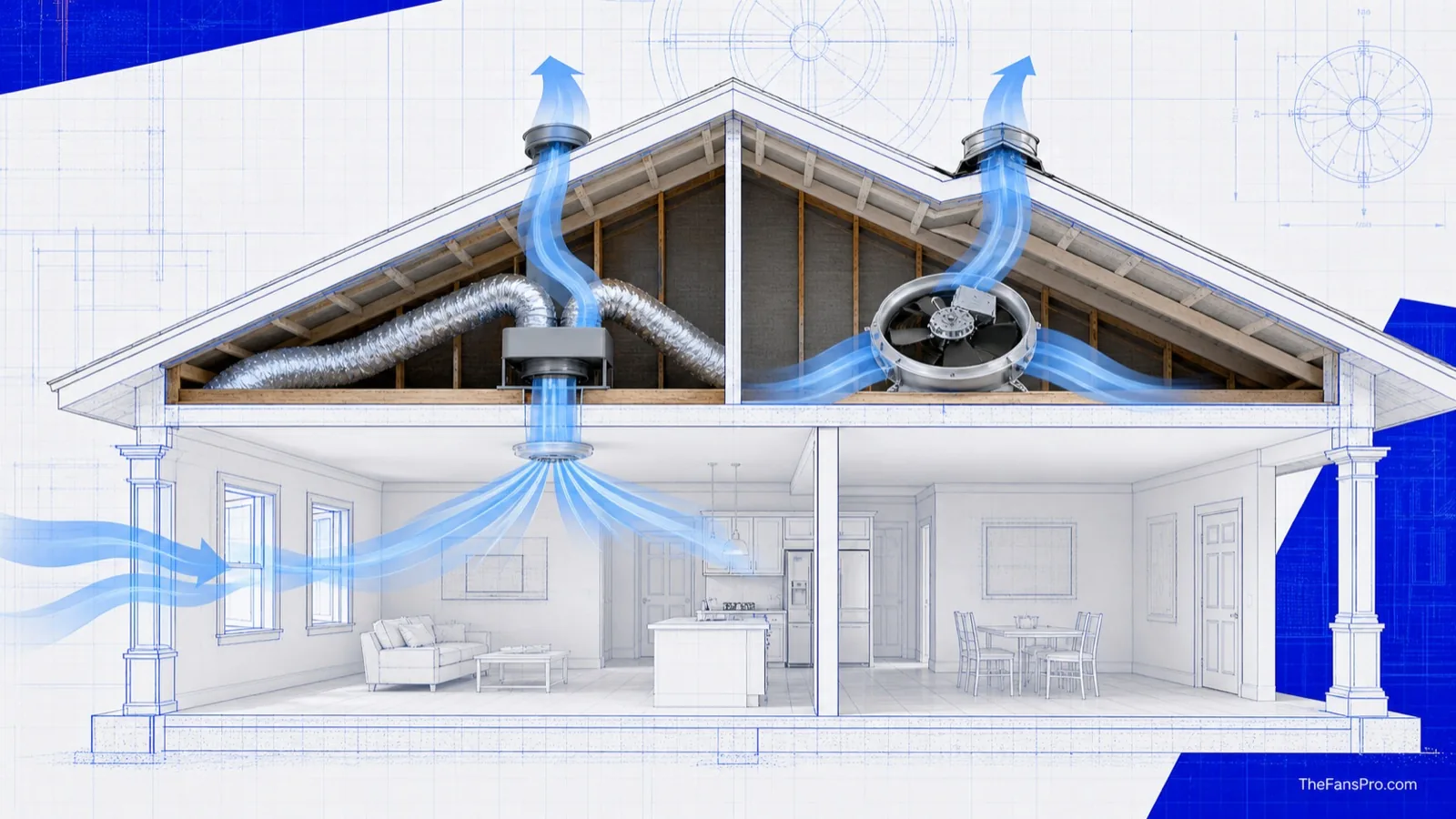
A whole-house fan cools the living space by pulling outdoor air through open windows. An attic fan ventilates the attic without intentionally pulling air through the rooms below. They sit near the same roof, but they solve different problems and can create different pressure and safety risks.
Follow the Air, and the Difference Is Obvious
The branded cutaway above shows the decisive difference. A whole-house fan draws outdoor air through open rooms and pushes it toward attic exhaust. A powered attic fan should move air only through the attic intake-and-exhaust path.
| Decision | Whole-house fan | Powered attic fan |
|---|---|---|
| Primary job | Cool occupied rooms with cooler outdoor air | Exhaust hot or moist attic air |
| Air intake | Open windows in the living space | Attic soffit, gable, or other intake vents |
| Best conditions | Cooler nights, typically drier climates, acceptable outdoor air quality | Only after air sealing, insulation, passive venting, and intake area are evaluated |
| Runs with AC? | No. It would exhaust conditioned air. | It can still pull conditioned air through ceiling leaks; fix the pressure path first. |
| Major sizing input | Conditioned volume, cooling strategy, attic exhaust area, open-window area | Attic assembly, intake area, manufacturer rating, climate and moisture strategy |
| Main risk | Depressurization, combustion backdrafting, inadequate windows/attic exhaust, unsealed winter opening | Pulling conditioned air from the house, backdrafting combustion equipment, bypassing blocked intake vents |
Whole-House Fan Sizing and Vent-Area Worksheet
This calculator applies the range summarized by the U.S. Department of Energy’s Building America Solution Center: roughly 0.20 to 0.375 CFM per cubic foot of conditioned space, equal to about 12 to 23 air changes per hour. It also checks the federal guidance for attic exhaust and open-window area. The example result updates immediately as you change a number.
The worksheet is not a permit, equipment selection, or installation design. Code, climate, manufacturer instructions, combustion appliances, duct/joist layout, fan sound, and measured net-free vent area can change the answer. Use an HVI-916-rated airflow where available.
When a Whole-House Fan Makes Sense
A whole-house fan is a night-flush cooling tool. It works when outdoor air has dropped below the indoor temperature. Open selected windows, turn off the air conditioner, and let the fan replace stored indoor heat with cooler outdoor air. The attic then needs enough exhaust area to release the same airflow.
The best fit is a house with a useful day-to-night temperature swing, acceptable nighttime outdoor air, secure openable windows, and no combustion or pressure conflict. The Building America guidance says whole-house fans are generally more appropriate for dry climates than humid ones. Wildfire smoke, pollen, outdoor noise, humidity, and security can all make the theoretical energy savings irrelevant.
Three numbers must agree
- Fan airflow: Building America summarizes an effective planning range of 12 to 23 air changes per hour, or 0.20 to 0.375 CFM per cubic foot.
- Attic exhaust: plan at least 1 square foot of net-free vent area for each 750 CFM unless the fan maker or local code requires more. Screens and louvers can cut the free area substantially.
- Open windows: federal guidance recommends at least 4 square feet of screened open-window area per 1,000 CFM. Count only the area that actually opens.
When a Powered Attic Fan Makes Sense
A powered attic ventilator is meant to exchange attic air, not cool people directly. It pulls air from low attic intake vents and exhausts it near the roof or gable. That only works as intended when the attic has a continuous intake path and the ceiling below is well air-sealed.
ENERGY STAR’s warning is blunt: with blocked soffit vents or a leaky ceiling, an attic fan can suck cool conditioned air out of the house, use more energy, and make the air conditioner work harder. Start with roof/attic inspection, ceiling-plane air sealing, insulation, and passive intake/exhaust balance. The fan is not the first repair for every hot attic.
Do You Need Both?
Sometimes a whole-house fan uses the attic as its exhaust plenum, but that does not mean a separate powered attic fan should run at the same time. The whole-house fan already pressurizes the attic and needs passive exhaust area sized for its airflow. A second exhaust fan can change the pressure balance without solving an undersized-vent problem.
Have the system designed as one air path. If the whole-house unit ducts directly outdoors, follow that manufacturer’s exhaust requirements. If it discharges into the attic, calculate the attic’s net-free vent area and inspect for air leaks back into the house.
The Installation Questions Worth Asking First
- Is the outdoor air reliably cooler than the house during the hours you would run a whole-house fan?
- Can enough windows be opened safely, and what is their actual screened open area?
- What is the attic vent system’s measured net-free area, not merely the grille dimensions?
- Is the ceiling plane air-sealed around lights, wiring, plumbing, chases, and the fan opening?
- Are any natural-draft combustion appliances inside the pressure boundary or attic?
- Does the fan have an insulated, gasketed damper or cover for the off-season?
- Is the published airflow certified under HVI-916?
- Will sound at the proposed location be acceptable at night?
Related Fan Decisions
A whole-house fan exchanges indoor and outdoor air. A room fan or air circulator only moves air within the room. A bathroom exhaust fan removes moisture and odors from one source room and must discharge outdoors. And a garage fan should never be used to pull garage air into the home.
Questions Homeowners Usually Mean to Ask
Will an attic fan cool my house?
Not directly. Its intended job is to move attic air. It may reduce attic temperature, but ENERGY STAR warns that a leaky ceiling can let the fan remove conditioned air from the rooms below and increase cooling use.
Can I run a whole-house fan with the windows closed?
No. The open windows are the designed intake. Without enough opening, the fan can depressurize the house, reduce airflow, and increase backdraft risk. Use the fan maker’s window-opening requirement when it exceeds the planning worksheet.
Can I run the air conditioner and whole-house fan together?
That defeats the basic cooling strategy because the fan exhausts conditioned indoor air. Shut the AC off and use the whole-house fan only when outdoor conditions are favorable.
Is a solar attic fan automatically efficient?
Solar power removes the fan’s grid-energy use, but it does not fix blocked intake vents, ceiling leaks, poor insulation, or pressure risks. Evaluate the attic assembly first.
Sources and Evidence Scope
Evidence label: Spec-verified. Airflow, vent-area, climate, pressure, and safety statements were checked against the following government and code sources on August 22, 2026. This draft is not a site-specific HVAC design.
The interactive worksheet needs JavaScript. The three-number sizing method and worked 4,000 CFM example above remain available without it.
