
Here’s what changed in smart ceiling fans while nobody was looking: the no-name Wi-Fi brands that flooded Amazon in 2022 are quietly disappearing. When I refreshed this guide in July 2026, four of my five previous picks had gone out of stock or been discontinued. The survivors are fans from real companies with real app support, and that’s the theme of this year’s list.
I’m Ryan, and ceiling-fan installation is the experience behind this site. Last model and availability check: July 2026. Recheck the exact model, finish and retailer listing before ordering because availability changes.
Shopping for both smart controls and useful room lighting? Compare Hunter ceiling fans with verified light output alongside the control requirements.
Our Top Picks
| Pick | Fan | Works with | Motor | Light |
|---|---|---|---|---|
| Best overall | Modern Forms Wynd 52” | Alexa, Google, ecobee | DC | Dimmable LED |
| Apple HomeKit | Hunter Aerodyne 52” | HomeKit, Alexa, Google | AC | Dimmable LED |
| Budget | CEME 52” | App, Alexa, Google | DC, 10-speed | Dimmable LED |
| Keep your fan | Meross MFC100 switch | HomeKit, Alexa, Google | — | Controls existing |
What Counts as a “Smart” Ceiling Fan?
A smart ceiling fan connects to your home network so you can run it from an app, by voice, or on schedules and temperature triggers. The useful version of that: the fan slows down at 2 a.m. without you getting up, kicks on before you get home, and the light dims from your phone.
One thing worth understanding before you spend money: “smart” almost always means Alexa and Google. Apple HomeKit support is rare and usually costs extra. If that’s what you’re after, we keep a dedicated guide to fans that work with Apple HomeKit.
Modern Forms Wynd 52” — Best Smart Ceiling Fan Overall
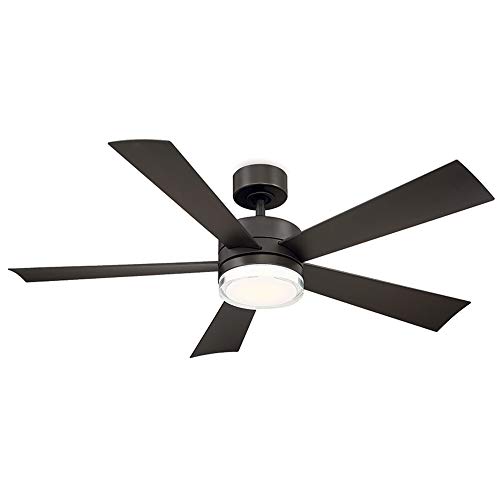
- 52-inch, quiet DC motor
- Alexa, Google & ecobee
- Damp-rated: covered patios OK
- Dimmable LED + remote
- No native HomeKit
The Wynd leads this comparison because Modern Forms publishes a DC motor, aluminum construction and app controls that include schedules, Away mode and adaptive-learning options. Treat those as model-specific features and confirm them on the exact current listing.
It’s damp-rated, so it’s just as happy over a covered patio as in a living room, and the dimmable LED puts out real light, not the glowing-donut token effort some fans ship.
Two honest caveats. First, there’s no native HomeKit; Alexa, Google, and ecobee are the supported platforms. Second, it costs several times what a builder-grade fan does. You’re paying for the motor and the build, and in this case the money shows.
Pros- Whisper-quiet DC motor with smooth speed control
- Damp-rated for indoor or covered outdoor use
- Polished, reliable app with schedules and away mode
- Serious light output, fully dimmable
- No native Apple HomeKit
- Premium price
Hunter Aerodyne 52” — Best for Apple Homes

- Built-in HomeKit
- Also Alexa & Google
- Dimmable LED + remote
- HunterSMART app
If your house runs on Siri, this is the shortcut: the Aerodyne is a fan with native HomeKit built in, plus Alexa and Google for mixed households. Pair it straight to the Apple Home app with no bridge, and the fan, its speed, and the dimmable LED all show up as proper Home controls.
Fair warning from the trenches: Hunter’s Wi-Fi pairing can be cranky on day one. Give it a close router and some patience during setup; after that it settles down and behaves.
Pros- Built-in HomeKit; check hub needs for automations
- Works with all three voice ecosystems
- Remote included; looks good in several finishes
- First-time Wi-Fi setup can take a couple of tries
- AC motor: fine, but not as sippy as the DC fans here
CEME 52” — Budget Smart Fan That Doesn’t Feel Like One

- 10-speed DC motor
- Dimmable LED, 3 color temps
- App + Alexa & Google
- Indoor/outdoor, 3 sizes
The one survivor from my 2022 list, and it earned the spot. For a fraction of the Wynd’s price you get a 10-speed DC motor, a dimmable LED with three color temperatures, and app control plus Alexa and Google. It comes in three sizes and four finishes, and it’s rated for covered outdoor spaces too.
Installation time depends on the ceiling box, wiring and exact mounting hardware. Follow the model manual rather than a generic time estimate. The lower price also comes with a less established app and support history than the long-running fan brands.
Pros- 10 speeds and a proper DC motor at a budget price
- Dimmable LED with selectable color temperature
- Fast install, multiple sizes and finishes
- App is functional, not slick
- Smaller brand; longevity of app support is the gamble
For Apple Home, use the exact-model options and control restrictions in our verified HomeKit fan guide. Matter branding alone does not verify Apple Home fan control.
Don’t Want to Replace the Fan? Check Whether a Wall Controller Fits
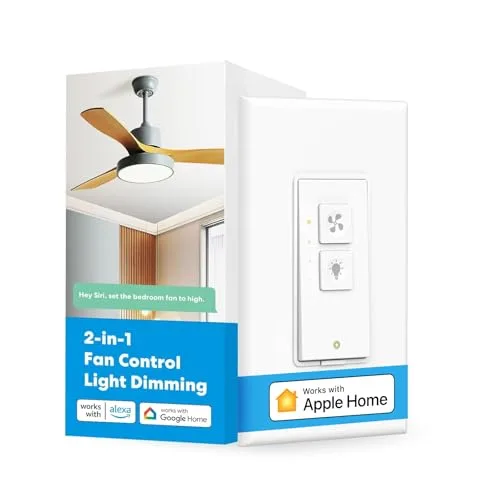
- Makes your existing fan smart
- 4 speeds + dimmable light
- HomeKit, Alexa & Google
- Needs neutral wire · AC fans only
The Meross MFC100 controls a compatible AC fan and a separate dimmable light. It requires a neutral wire and separate load wires, and is not for DC fans or integrated remote-controlled fans. Check the HomeKit controller comparison before ordering.
Requirements: a neutral wire in the box and a standard AC-motor fan without its own RF receiver. If your fan runs on a handheld remote, a switch will fight it. That setup wants a Bond Bridge instead.
How to Choose (the Short Version)
Match the ecosystem first
Buy for the voice assistant you already use. Alexa/Google homes have the full menu. Apple homes should compare an exact HomeKit fan model with a controller that explicitly supports the existing motor and wiring.
Favor DC motors
DC motors run quieter, give you more speeds, and draw a half to a third of the power of an AC motor. Running one 8 hours a day costs roughly $5 to $10 a year in electricity. On a fan you run all summer, that’s the spec that matters most after size.
Think about who keeps the servers on
A smart fan is only as smart as the company’s cloud. The 2022 wave of bargain Wi-Fi fans proved the point: several of those brands are gone, and their apps went with them. Buy from companies that will still exist in five years, or keep the smarts in a $40 switch you can swap in an afternoon.
Size still rules
Smart features can’t fix a 42-inch fan in a 20-by-20 room. Size to the space first (our fan size chart makes it a 30-second job), then pick the smart features.
Our Verdict
Get the Modern Forms Wynd if you want the best smart fan, full stop. It’s the pick our readers keep validating with their wallets. Apple households should go Aerodyne, tight budgets go CEME, and if the fan on your ceiling is already fine, spend $40 on the Meross switch and pocket the difference.
Not every smart fan has a light worth having. We ranked the lighted models on airflow per watt in best ceiling fans with lights.
As an Amazon Associate, TheFansPro earns from qualifying purchases.
Smart Ceiling Fan FAQ
Do smart ceiling fans need a hub?
Most current Wi-Fi fans, including the Wynd, Aerodyne, and CEME, connect straight to your router with no hub. The exceptions: Lutron’s Caséta system needs its bridge, and fans you smarten up through a Bond Bridge need that box.
Do smart ceiling fans work with Alexa and Google?
Almost all of them; that’s the default pairing. Every fan on this list does both, for power, speed, and light by voice. Apple HomeKit is the rare one; only the Aerodyne here has it natively.
What happens if the fan maker’s app shuts down?
The fan keeps spinning, but the app, voice control, and schedules die with the servers. This isn’t hypothetical; it’s what happened around several of the bargain brands from a few years back. It’s the strongest argument for established brands, or for keeping the smarts in a wall switch you can replace in an afternoon.
Do smart fans still work when the Wi-Fi is down?
Yes. Every fan here still runs from its remote or pull chain with no internet. You lose the app, voice, and schedules until the connection comes back. The blades don’t care.
Are smart ceiling fans worth it?
If you’ll use the automation, absolutely. Temperature triggers and a fan that slows itself at night get used every single day, and DC motors cost single-digit dollars a year to run. If all you want is on/off from the couch, the $40 switch route gets you most of the way there.
Related Guides
For Apple users, start with our best HomeKit ceiling fans guide. If efficiency is the goal, see the most energy-efficient ceiling fans, for a bright light plus a remote check our fans with lights and remote, and shop cooling is covered in the best garage ceiling fans.
Check the control path before buying. A fan with pull chains, a radio remote, a DC receiver or built-in Wi-Fi needs a different solution. Use the smart ceiling fan compatibility checker to match Apple Home, Alexa, Google Home or Matter to the controls and wiring you actually have.
