
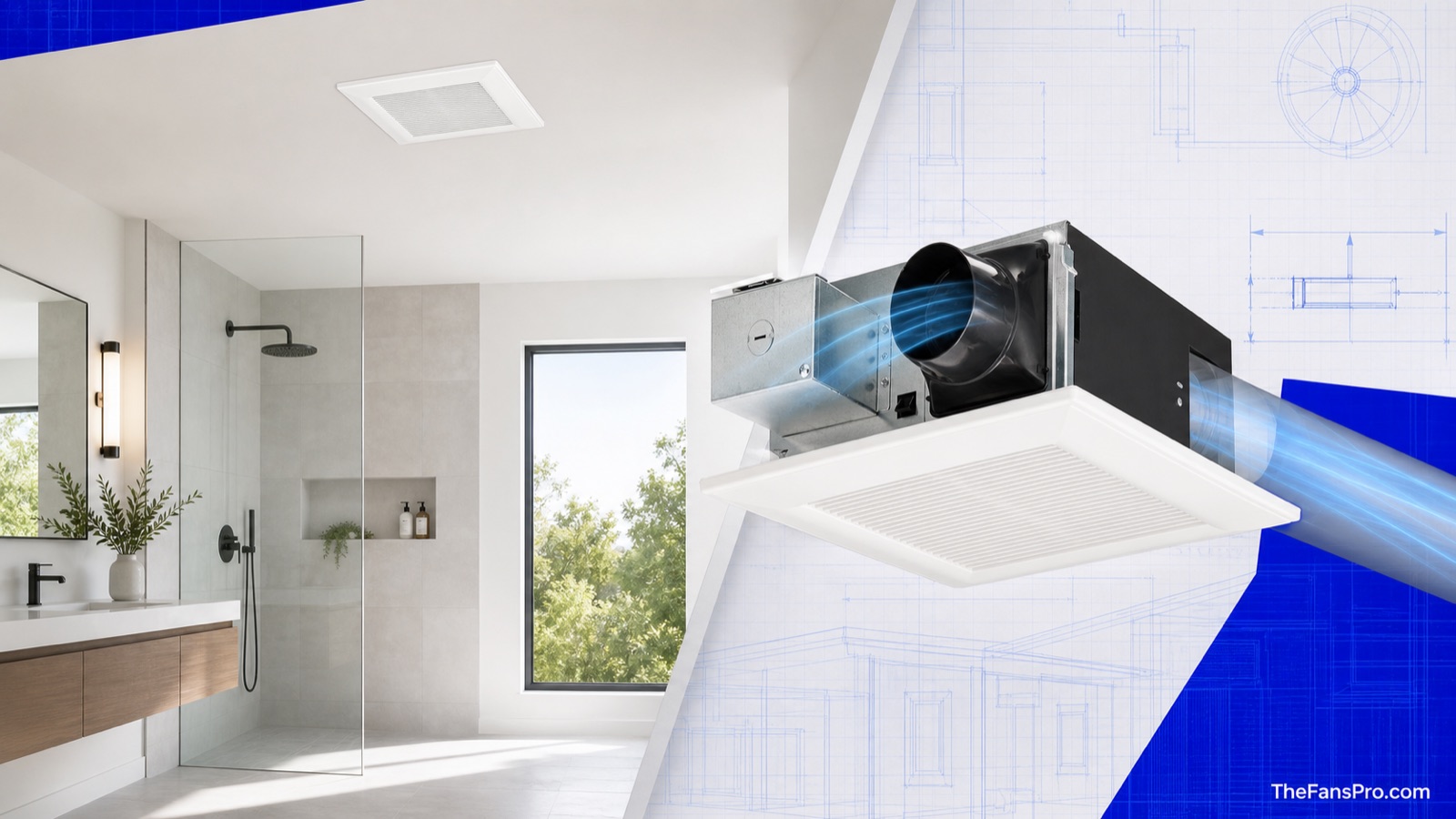
The quietest bathroom fan is not the model with the smallest number printed biggest on the box. Compare HVI-certified airflow and sound at the speed you will use, then check performance at 0.25 inches of static pressure when it is published. Duct resistance can turn a quiet showroom number into weak installed ventilation.
HVI-Rated Shortlist
| Model | Airflow | Published sound | Duct / install | Best use | Evidence note |
|---|---|---|---|---|---|
| Panasonic FV-0511VF1 | 50 / 80 / 110 CFM | Up to 0.8 sones standard; 1.2 at 0.25 in. w.g. at high setting | 4-inch; 5-5/8-inch housing; retrofit from below | Best overall retrofit | Current ENERGY STAR record captured June 25, 2026 |
| Broan AE50110DC | 50 / 80 / 110 CFM | <0.3 / 0.4 / 1.0 sones | 4-inch; room-side; 5-3/4-inch housing | Selectable Broan alternative | HVI-rated values in manufacturer specification |
| Panasonic FV-0511VQ1 | 50 / 80 / 110 CFM | Manufacturer publishes separate low-sone ratings by speed, duct, and static pressure | 4 or 6-inch; deeper new-work housing | New construction / accessible ceiling | Use the exact pressure/speed/duct column in the submittal; do not quote one headline number |
| Broan AE110 | 110 CFM | 1.0 sone | 4-inch; room-side | Simple single-speed replacement | Less flexible, easier buying decision |
| Delta SIG80-110 | 80 / 110 CFM at 0.1 and 0.25 | With 6-inch duct: <0.3 at 0.1; 0.5 / 0.8 at 0.25 | 6-inch; 4-inch reducer included | Quiet selectable fan when a 6-inch run is possible | Four-inch duct raises sound sharply at 0.25-inch pressure |
Sone ratings are comparable only when the test condition and speed match. “<0.3” is the lowest currently certifiable residential sound rating; it does not mean silent in an installed room.
1. Panasonic WhisperFit FV-0511VF1: Best Overall Retrofit

Pick-A-Flow 50 / 80 / 110 CFM
This is the clean default because one exact fan covers three common bathroom sizes, uses a low-profile housing, and installs from below the ceiling. Panasonic publishes sones at 0.25-inch static pressure as well as the standard rating, which makes the specification more useful for a real duct run.
At 110 CFM, ENERGY STAR lists 0.8 sones under the standard sound rating and 1.2 sones at 0.25-inch pressure. That increase is not a flaw; it is honest evidence of what resistance does.
2. Broan AE50110DC: Best Selectable Alternative
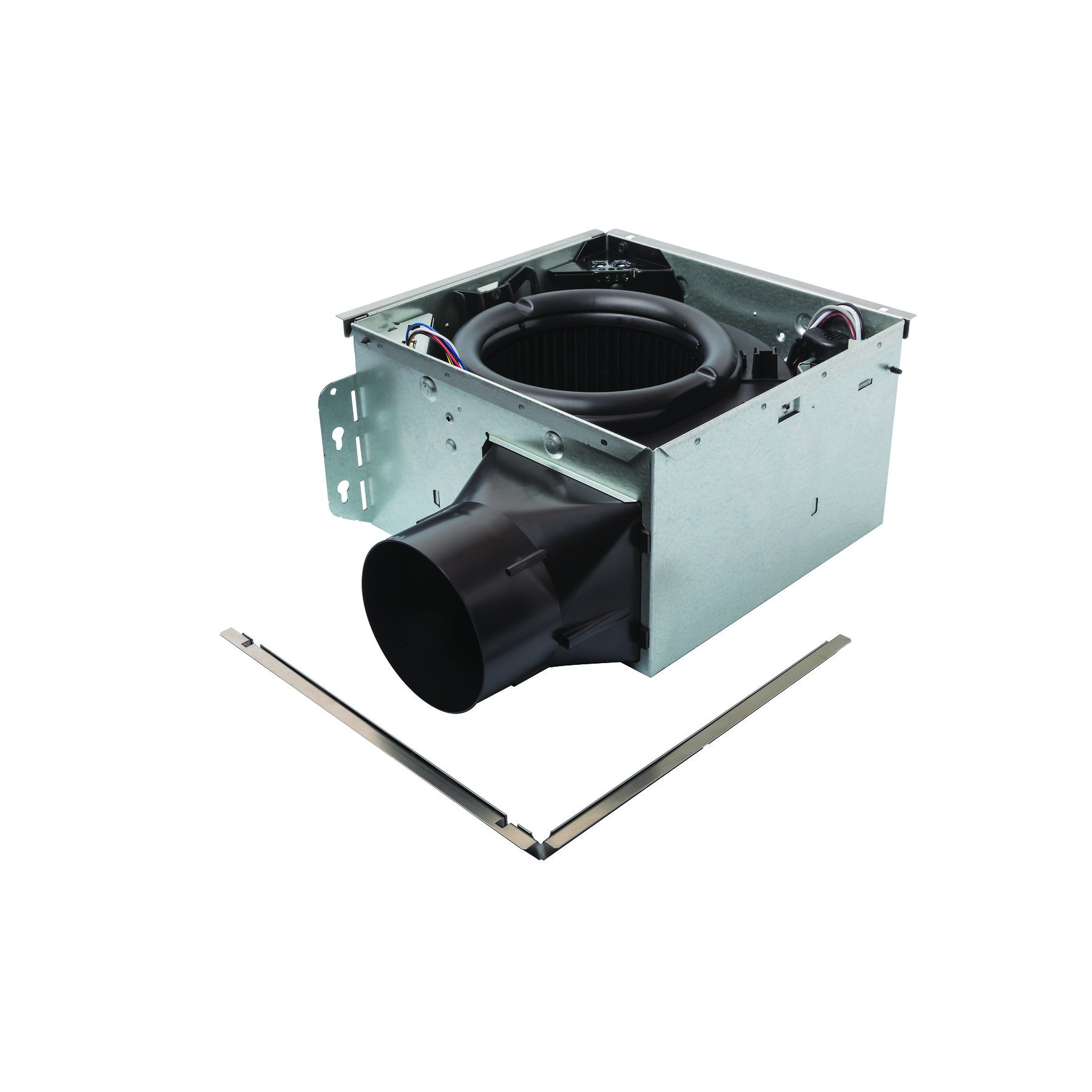
Flex DC 50 / 80 / 110 CFM
Broan publishes <0.3, 0.4, and 1.0 sones across its three settings. The four-inch connector, 5-3/4-inch housing, room-side installation, continuous-duty brushless DC motor, and shower/tub listing when used on a GFCI-protected circuit make it unusually easy to scope.
The selectable switch also prevents a common buying mistake: committing to 50 CFM before discovering the room, ceiling height, or shower layout needs more.
3. Panasonic WhisperCeiling FV-0511VQ1: Best for New Work
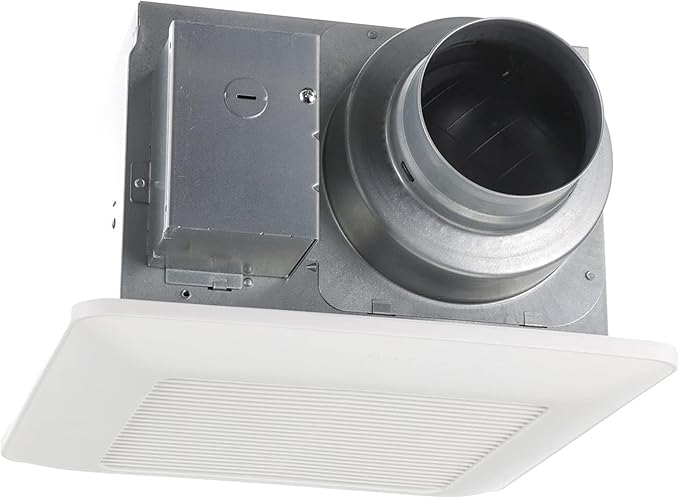
Deeper housing, 4- or 6-inch duct option
WhisperCeiling is the better fit when the ceiling is open and housing depth is not the constraint. The official table publishes airflow and sound at both 0.1 and 0.25 inches of pressure. That lets the designer choose the duct size and setting instead of treating “110 CFM” as a guaranteed installed result.
Do not substitute it blindly for WhisperFit in a retrofit: the housing and mounting strategy differ.
4. Broan AE110: Best Simple 110 CFM Choice
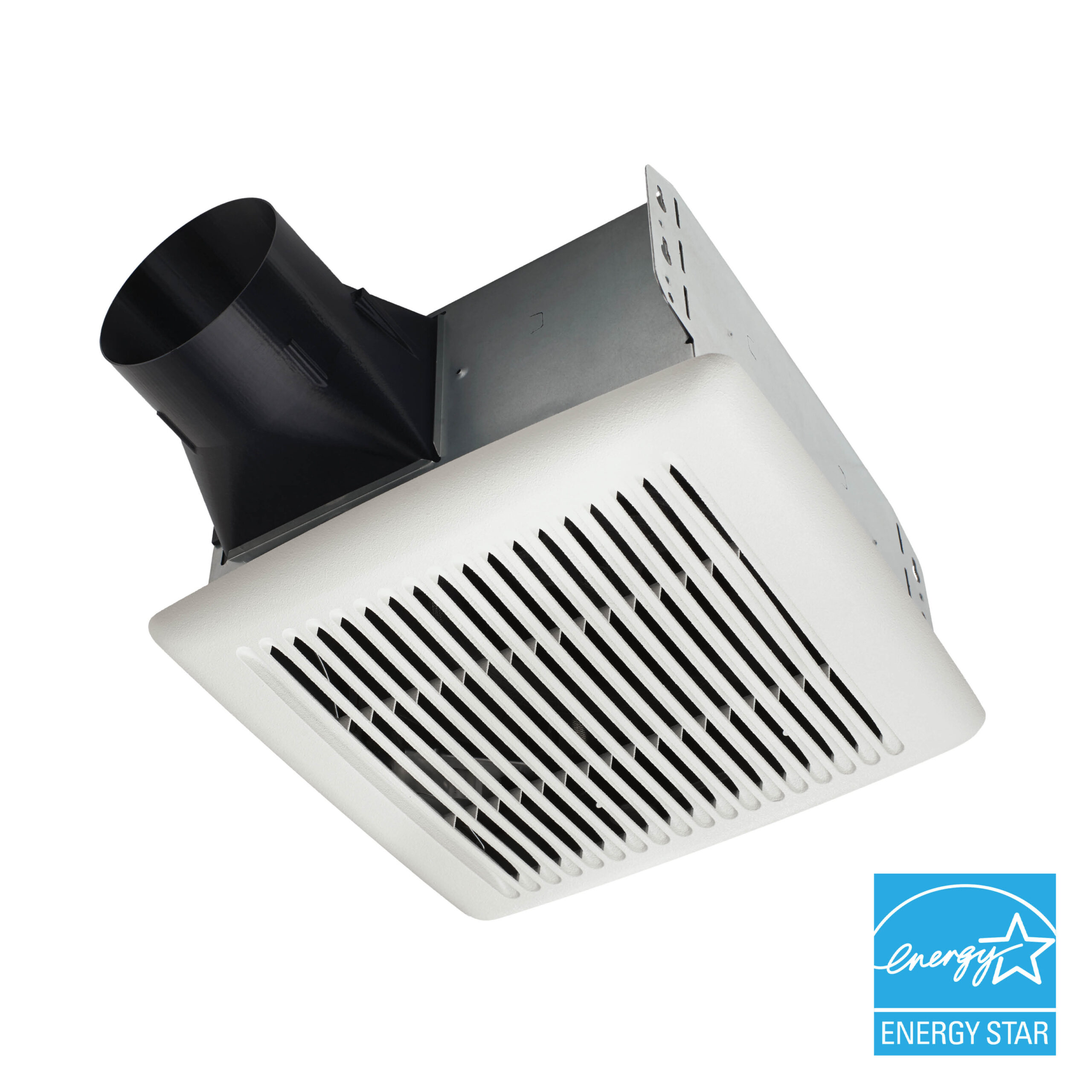
Flex Series AE110
AE110 is the straightforward alternative for a bathroom already scoped for 110 CFM. Broan lists 1.0 sone, ENERGY STAR certification, four-inch ducting, and room-side installation. It gives up the selectable motor, but that is not automatically bad when the room and duct are already known.
5. Delta SIG80-110: Best When You Can Use a 6-Inch Duct
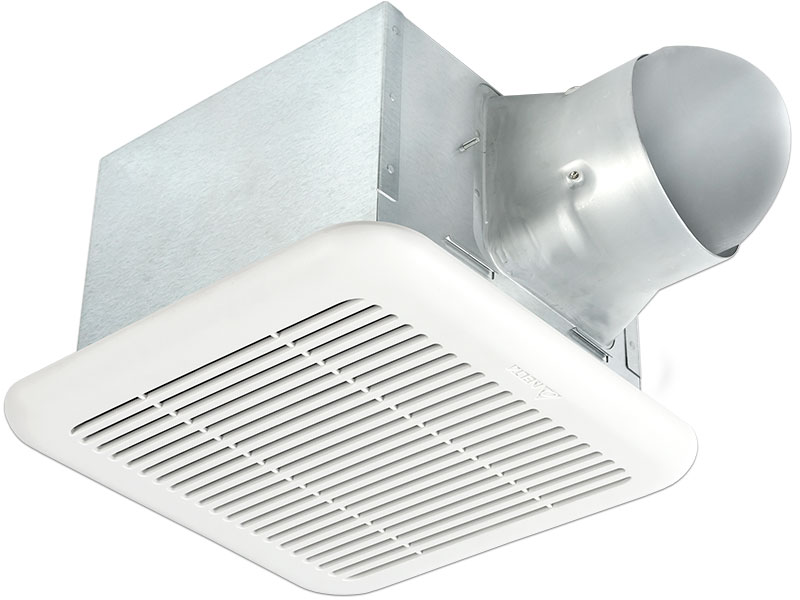
BreezSignature selectable 80 / 110 CFM
Delta’s current SIG80-110 holds its selected 80 or 110 CFM at both 0.1 and 0.25 inches of static pressure. With the standard six-inch duct, Delta publishes less than 0.3 sones at either airflow under the 0.1-inch test and 0.5 / 0.8 sones at 0.25 inches.
The included four-inch reducer changes the result: at 0.25 inches, the official table rises to 1.2 sones at 80 CFM and 2.0 sones at 110 CFM. Choose this fan when a smooth six-inch route is realistic, not because the box includes a reducer.
How Much CFM Does the Bathroom Need?
HVI’s current homeowner guidance is more specific than “always buy 110 CFM”:
- Under 50 square feet: use at least 50 CFM.
- 50–100 square feet: use at least 1 CFM per square foot.
- Over 100 square feet: add 50 CFM each for the toilet, shower, and bathtub, or 100 CFM for a jetted tub.
- Enclosed toilet room: give it its own fan.
- Ceilings above eight feet: additional ventilation may be needed.
Why the Duct Can Beat the Fan
Rated airflow is measured at defined static pressure. A restrictive grille, undersized duct, sharp elbows, crushed flex, long routing, and a sticky exterior damper increase resistance. Do not “compensate” by guessing at a larger fan. Compare the manufacturer’s performance curve or 0.25-inch rating and design the duct within the instructions.
Use the fan’s accepted duct size. Keep the path short and smooth where the building allows it. Exhaust outdoors through an approved termination—not into the attic, soffit cavity, or another room.
How Quiet Is Quiet?
HVI describes one sone as roughly the loudness of a quiet refrigerator and says doubling the sone value doubles perceived loudness. For quiet bathroom ventilation, HVI recommends 1.0 sone or less. Extremely quiet fans pair well with timer or humidity controls because occupants may not notice they are running.
Timer, Humidity Sensor, or Ordinary Switch?
A timer creates predictable post-use ventilation. A humidity sensor can respond when occupants forget, but placement and trigger logic matter. An ordinary switch is simplest but relies entirely on behavior. Choose the control after checking whether it is built into the exact model or requires a compatible wall control.
For the difference between room exhaust and other ventilation systems, see attic fan vs whole-house fan.
As an Amazon Associate, TheFansPro earns from qualifying purchases.
Sources and Evidence Scope
Evidence label: Spec-verified. No fan was installed, sound-metered, or airflow-tested for this review copy. Ratings and installation limits were checked against HVI, ENERGY STAR, and current manufacturer records on August 22, 2026.
