
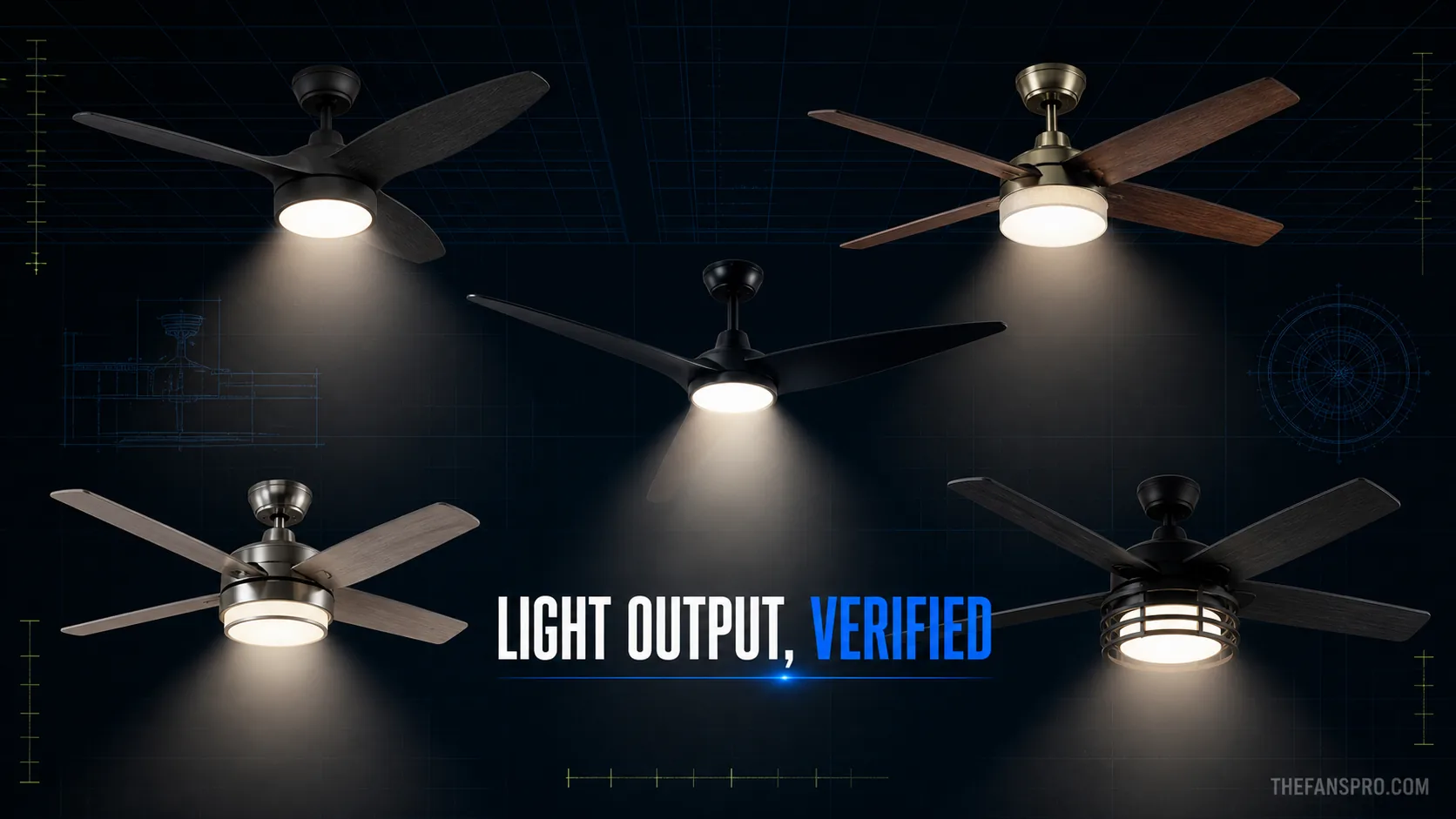
“LED light included” tells you almost nothing about how well a ceiling fan will light a room. Hunter currently publishes actual light output for several models, and the useful group starts around 1,700 lumens. That is enough to compare real illumination alongside airflow, room size, mounting style, and controls instead of trusting a vague “bright light” badge.
This is a spec-verified comparison of five exact Hunter models that were listed in stock on Hunter’s site on August 22, 2026. We did not bench-measure these fixtures. Published lumens are manufacturer values for the exact item numbers shown below; brightness in a finished room will also depend on the diffuser, ceiling height, wall colors, and where task lighting is needed.
As an Amazon Associate, TheFansPro earns from qualifying purchases.
The short answer
Pick the ZenTech 52 when you want 2,000 lumens, adjustable color temperature, smart control, and covered-outdoor flexibility in a normal large room. Pick the Gravity 60 when the room is larger and Apple Home compatibility matters. Pick the Solaria 60 for the highest airflow here and a covered patio or garage. The Malden 52 gives you tunable light without an app, while the Minimus 44 is the right geometry for a smaller room with a low ceiling.
| Model | Published light | High airflow | Mount / location | Best fit |
|---|---|---|---|---|
| ZenTech 52, 53638 | 2,000 lm; 3,000–5,000K | 5,443.94 CFM | Downrod; damp | Best overall feature mix |
| Gravity 60, 51951 | 2,000 lm; 3,000K | 6,468 CFM | Downrod; indoor | Large smart room |
| Solaria 60, 59625 | 2,000 lm; 3,000K | 7,307 CFM | Downrod; damp | Covered patio or large room |
| Malden 52, 53546 | 1,700 lm; 3,000–5,000K | 4,970 CFM | Downrod; indoor | Tunable white without Wi-Fi |
| Minimus 44, 59453 | 1,700 lm; 3,000K | 3,181 CFM | Low profile; indoor | Low ceiling / small room |
Five current Hunter fans with verified light output

Hunter ZenTech 52 — item 53638
- 2,000 lumens
- 3,000–5,000K
- 5,443.94 CFM high
- HunterSMART + remote
The ZenTech is the most complete lighting package in this group. Hunter publishes a 25-watt integrated LED rated at 2,000 lumens, with adjustable color temperature and multiple brightness levels. The 52-inch, five-blade fan uses a six-speed DC motor and is damp-rated for covered outdoor spaces as well as indoor rooms.
Best for: a living room, covered porch, or larger bedroom where one fixture has to provide useful general light and smart control. It supports Alexa, Apple Home, and Google Home through HunterSMART, while the included handheld remote keeps ordinary operation available without voice control.
Skip it if: the fan will receive direct rain. Damp-rated is not wet-rated. Also skip it if you specifically want standard replaceable bulbs; this uses an integrated LED module.
Search Amazon for Hunter ZenTech 53638
Spec-verified against Hunter’s current ZenTech 52 product record on August 22, 2026.

Hunter Gravity 60 — item 51951
- 2,000 lumens
- 6,468 CFM high
- Six-speed DC motor
- Apple, Alexa and Google
The Gravity combines the same 2,000-lumen headline output with a larger 60-inch sweep and 6,468 CFM published high airflow. Its 24-watt integrated LED is dimmable at a fixed 3,000K, and the matte-black 51951 variant was the in-stock version when checked.
Best for: a great room, open living area, or large bedroom where a 52-inch model would underserve the room. It is also the cleanest bridge between this guide and our smart ceiling fan compatibility guide.
Skip it if: you want selectable color temperature or outdoor placement. It is indoor-rated and the light is 3,000K.
Search Amazon for Hunter Gravity 51951
Spec-verified against Hunter’s current Gravity 60 product record on August 22, 2026.

Hunter Solaria 60 — item 59625
- 2,000 lumens
- 7,307 CFM high
- Damp-rated
- Wall control
The Solaria publishes the highest airflow in this comparison: 7,307 CFM on high. Its 24-watt, 2,000-lumen integrated LED is dimmable at 3,000K, and the six-speed DC fan includes an integrated wall control. Hunter lists it for covered outdoor spaces, not direct weather.
Best for: a large covered patio, garage, gym, or great room where strong fan performance matters as much as the light. The wall control may also be preferable in a high-traffic room where a handheld remote would migrate.
Skip it if: the location is exposed to rain, or you need app control. For a wet outdoor location, compare the wet-rated models in our outdoor ceiling fan guide.
Search Amazon for Hunter Solaria 59625
Spec-verified against Hunter’s current Solaria 60 record and model sheet on August 22, 2026.

Hunter Malden 52 — item 53546
- 1,700 lumens
- 3,000–5,000K
- 4,970 CFM high
- Handheld remote
The Malden gives up 300 published lumens versus the three leaders, but keeps the feature many rooms need more: a choice among warm, neutral, and cooler white light. The 52-inch fan uses a three-speed AC motor, publishes 4,970 CFM on high, and includes a handheld remote.
Best for: a bedroom, office, or living room where you want brighter daytime light and warmer evening light without adding an app or Wi-Fi dependency.
Skip it if: energy efficiency or six-speed control is the priority. Its published high-speed energy use is 44 watts, well above the DC models in this comparison.
Search Amazon for Hunter Malden 53546
Spec-verified against Hunter’s current Malden 52 product record on August 22, 2026.

Hunter Minimus 44 — item 59453
- 1,700 lumens
- Low-profile mount
- 3,181 CFM high
- Handheld remote
A bright 60-inch downrod fan is useless in a small room with an eight-foot ceiling. The Minimus solves that geometry problem with a 44-inch, low-profile body while still publishing 1,700 lumens from its dimmable 16-watt integrated LED. Its light is fixed at 3,000K.
Best for: a small bedroom, office, laundry room, or similar low-ceiling space. Compare its dimensions with the exact room guidance in our small-room and low-ceiling guide.
Skip it if: the room is large or the ceiling is sloped. Low-profile fans are not interchangeable with downrod fans, and Hunter does not position this one for angled mounting.
Search Amazon for Hunter Minimus 59453
Spec-verified against Hunter’s current Minimus 44 product record on August 22, 2026.
How many lumens should a ceiling-fan light have?
There is no single right number because the ceiling fixture is only one layer of a room’s lighting. Still, published lumens let you make a meaningful comparison:
- Around 800 lumens: similar to one familiar 60-watt-replacement bulb; often accent or supplemental light in a larger room.
- Around 1,600–1,700 lumens: a much stronger general-light starting point, especially in a smaller or lighter-finished room.
- Around 2,000 lumens: the strongest current Hunter group in this comparison, but still not a guarantee that one central diffuser will replace task lamps in every layout.
If the room has dark walls, a high ceiling, or work surfaces around the perimeter, plan lighting as a system. A ceiling-fan light can provide general illumination while lamps, sconces, or recessed fixtures handle tasks and corners.
Integrated LED or replaceable bulbs?
Every fan above uses an integrated LED module. That allows a slim diffuser and, on some models, color-temperature control. The tradeoff is serviceability: when a proprietary module or driver fails outside warranty, you need a compatible replacement rather than a standard bulb.
Before buying, check the current light-kit warranty and parts page for the exact item number. If long-term bulb-level serviceability matters more than a thin housing, use the broader ceiling fans with lights comparison, which explicitly separates integrated modules from replaceable-bulb designs.
What the lumen number does not tell you
- Delivered versus source output: a diffuser can reduce the light that reaches the room. Compare like with like when the manufacturer publishes both.
- Distribution: one bright central dome may still leave a desk or countertop shadowed.
- Color rendering: lumens describe quantity, not how accurately colors appear.
- Color temperature: 3,000K feels different from 5,000K even at the same lumen output.
- Dimming range: “dimmable” does not tell you the lowest stable setting or whether wall-switch dimming is supported.
Installation checks before ordering
- Confirm the mounting box is marked for fan support and attached to the structure.
- Match low-profile versus downrod mounting to ceiling height; check finished blade height, not only ceiling height.
- Use only the controls and wiring arrangements allowed by the exact manual. A standard light dimmer is not a substitute for a fan speed control.
- For a covered outdoor installation, verify the fan’s damp rating and keep it out of direct water. None of the five models above is presented here as a wet-location fan.
- Check the exact item number, finish, included control, and current stock immediately before purchase.
Bottom line
The ZenTech 52 is the best overall current Hunter choice when a genuinely bright, adjustable light is the main goal. The Gravity and Solaria make more sense for large rooms; the Malden trades some output for simple tunable-white control; and the Minimus solves the low-ceiling problem. Choose the fan that fits the room first, then use verified lumens to break the tie.
