
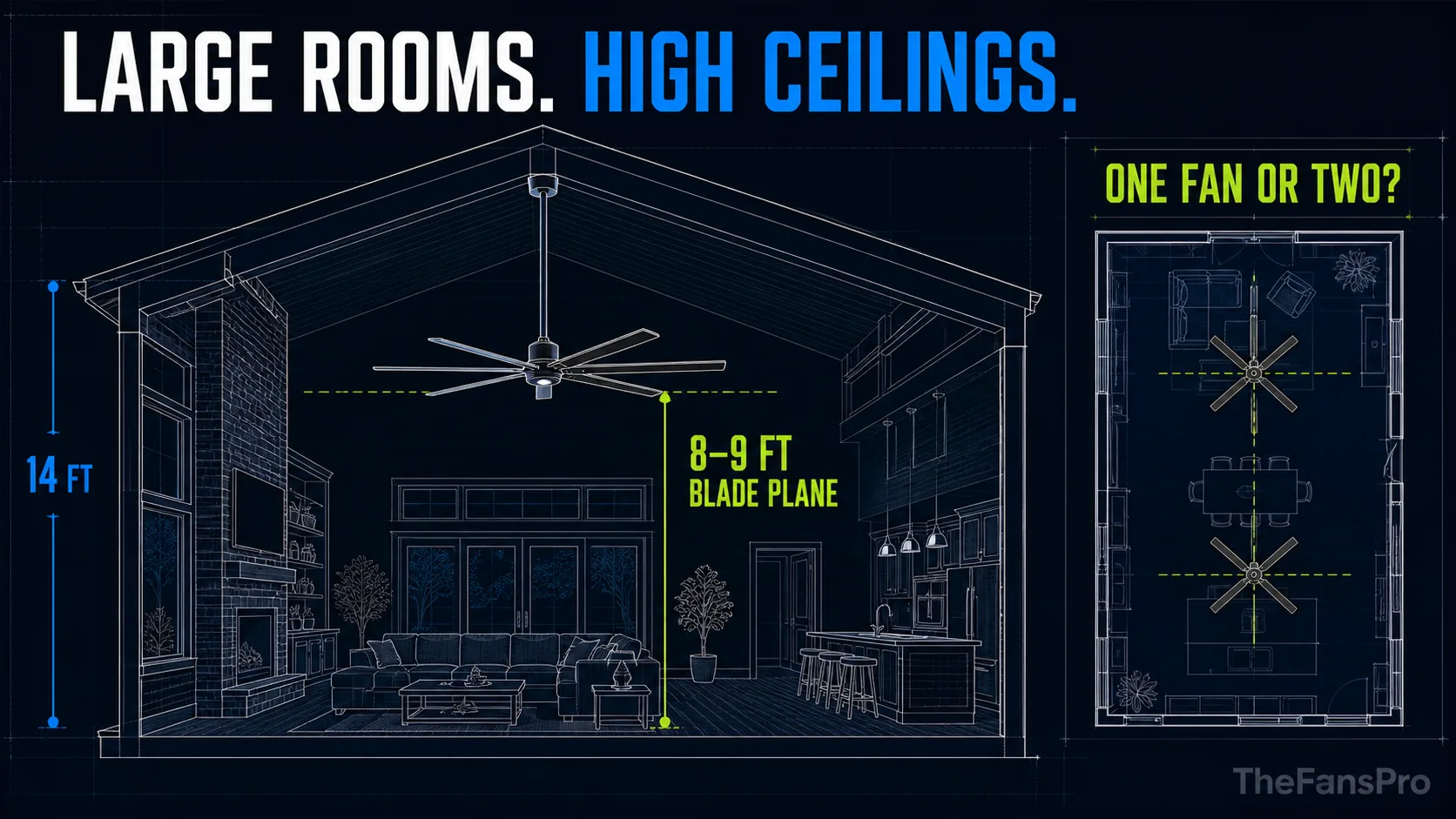
A large room and a high ceiling create two separate fan decisions. Blade span and airflow have to suit the floor area; downrod length has to put the blades at a useful height. Buying the biggest fan you can find does not automatically solve either problem.
This guide is for rooms over about 400 square feet, ceilings 10 feet and higher, long great rooms, open plans, and vaulted ceilings. It combines federal placement guidance with manufacturer installation rules, then shows when one large fan or two smaller fans makes more sense.
The short answer
- Start with floor area: ENERGY STAR’s consumer guidance places 50- to 54-inch fans in the 225- to 400-square-foot band. For a room larger than 400 square feet, current manufacturer guides commonly move to 56 inches or more, but published airflow matters as much as diameter.
- Then solve blade height: DOE guidance places fan blades at least 7 feet above the floor; 8 to 9 feet is a useful target when the room and exact fan allow it.
- Use two fans for a long room: DOE’s HVAC guide says multiple fans work best in rooms longer than 18 feet. Two airflow zones can be better than one oversized fan in the middle.
- Check the exact installation system: downrods, couplers, sloped-ceiling adapters, support boxes, and maximum slope limits are brand- and model-specific.
Step 1: measure the room, not the listing title
Multiply room length by room width to get square feet. Then note the room’s shape. A 20-by-20-foot square room and a 10-by-40-foot room both equal 400 square feet, but they do not distribute air the same way. A single centered fan has a much harder job reaching both ends of the long room.
| Room condition | Starting plan | What decides the final choice |
|---|---|---|
| 225–400 sq ft, roughly square | 50–54 in is the ENERGY STAR starting band | Published high-speed airflow, blade clearance, room use, and mounting height |
| Over 400 sq ft, roughly square | Compare 56 in and larger fans | Published airflow and the manufacturer’s stated application—not span alone |
| Longer than 18 ft | Price and place a two-fan layout | Occupied zones, beam/lighting conflicts, and electrical locations |
| Open plan with distinct seating and dining zones | Treat each occupied zone as its own airflow problem | Whether one fan can be centered over each zone without interference |
| Vaulted or sloped ceiling | Measure height and slope at each proposed fan location | Exact fan slope limit, compatible adapter, downrod system, and clearances |
Our ceiling-fan size chart covers the ordinary room-size bands. For a large room, use that only as the opening filter. Compare the high-speed cubic-feet-per-minute figure published for each exact model, plus the installation clearances in its manual.
Step 2: calculate a useful downrod starting point
A tall ceiling does not help if the fan stays stranded near the roof. Airflow at the occupied level improves when the fan is lowered to a useful blade plane, subject to the fan’s installation limits and required clearances.
ceiling height at the fan − desired blade height − fan body/drop below the downrod = approximate downrod length
Example: a room has a 14-foot ceiling at the fan location. You want the blades around 9 feet above the floor, and the selected fan’s body places the blades about 1 foot below the bottom of its downrod. The planning result is 14 − 9 − 1 = about a 4-foot downrod. That is a geometry check, not an order number: use only lengths and couplers approved by the exact fan manufacturer.
| Ceiling height | Common planning range | Verify before buying |
|---|---|---|
| 10 ft | About 12–18 in downrod | Finished blade height and total fan drop |
| 11 ft | About 18–24 in | Available manufacturer-approved lengths |
| 12 ft | About 36 in | Fan body depth and required wiring extension |
| 13 ft | About 48 in | Coupler rules, sway, and slope compatibility |
| 14 ft | About 60 in | Actual blade plane; do not use ceiling height alone |
| 15 ft | About 72 in | Exact model’s long-downrod support and installation instructions |
The ranges above are a planning shortcut reflected in Hunter’s current guidance, not a universal parts chart. Our dedicated ceiling-fan downrod chart explains finished height, rod diameter, threads, wiring, and why a generic rod is not automatically compatible.
One large fan or two fans?
One fan usually fits when
- the room is close to square;
- the occupied area is centered;
- a fan can sit near the room center;
- the selected model publishes enough airflow for the application;
- blades clear walls, beams, lights, and doors.
Two fans usually fit when
- the room is longer than about 18 feet;
- seating and dining areas form separate zones;
- a beam or light layout splits the ceiling;
- one giant fan would still leave dead zones;
- two smaller fans can be centered over where people actually sit.
Do not just divide the room into two equal rectangles and stop. Center fans over the occupied zones while preserving every clearance in both manuals. Two fans also mean two fan-rated support locations, power/control planning, and a decision about whether the controls should operate together or independently.
Three worked layouts
20 × 22 ft great room, 12 ft flat ceiling
The room is 440 square feet and close to square. Start by comparing 56-inch-and-larger models with clearly published airflow. A centered single fan may work if its blade clearances and airflow suit the room. Plan around a roughly 36-inch downrod, then correct for the actual fan body so the blade plane stays near the target height.
14 × 30 ft living/dining room, 10 ft ceiling
The room is 420 square feet but 30 feet long. Two fans—one over the living zone and one over the dining zone—deserve the first layout. The 10-foot ceiling means a relatively short downrod can often preserve an 8- to 9-foot blade plane. Check pendant lights and cabinet doors as well as walls.
18 × 24 ft room, vaulted from 10 to 16 ft
Area is 432 square feet, but “16-foot ceiling” is not enough information. Measure the height and slope at the proposed mounting point. Confirm the exact fan’s permitted slope and approved adapter before selecting the rod. A fan placed high on the ridge without enough drop may look centered while delivering a weaker breeze where people sit.
Vaulted-ceiling details that change the answer
- Slope angle: standard mounting hardware has a maximum permitted angle. A brand’s adapter may extend it, but the number is not universal.
- Blade clearance: a downrod must lower the blades far enough to clear the descending ceiling, beams, lights, and walls throughout the rotation.
- Support: the electrical box and structure must be listed or otherwise approved for fan support. A light-only box is not enough merely because it already holds a fixture.
- Control access: receivers and canopies may be harder to service at height. Record the model and receiver information before the lift leaves.
- Cleaning and maintenance: plan realistic access to blades, light components, and reversal controls.
Before installation, use our fan-rated box guide to understand the support decision. Have a qualified electrician or installer verify the mounting system when the framing, box, wiring, or high-access work is uncertain.
What to compare on an actual fan
- High-speed airflow: use the published CFM for the exact model and configuration.
- Blade span: confirm physical clearance; do not treat span as airflow by itself.
- Approved downrods: match brand, diameter, threads, finish, maximum length, couplers, and wire-extension rules.
- Slope support: read the manual for the standard maximum and required adapter.
- Location rating: a damp or wet room needs the appropriate rating.
- Control range: decide whether one or two fans need independent wall, remote, or smart control.
- Serviceability: verify replacement controls, light components, warranty, and high-ceiling access.
As an Amazon Associate, TheFansPro earns from qualifying purchases.
Search Amazon for manufacturer-compatible downrods
Match the fan manufacturer, series, diameter, thread, finish, and approved length before ordering. “Universal” in a listing title is not proof of compatibility.
Bottom line
For a large room, choose the number and placement of fans from the room’s shape and occupied zones. Choose span and airflow from the floor area and exact model data. Choose downrod length from finished blade height. If the room is long, seriously price two fans; if the ceiling is vaulted, verify slope and clearance at the actual mounting point. Those four decisions matter more than buying the widest fan on the page.
