
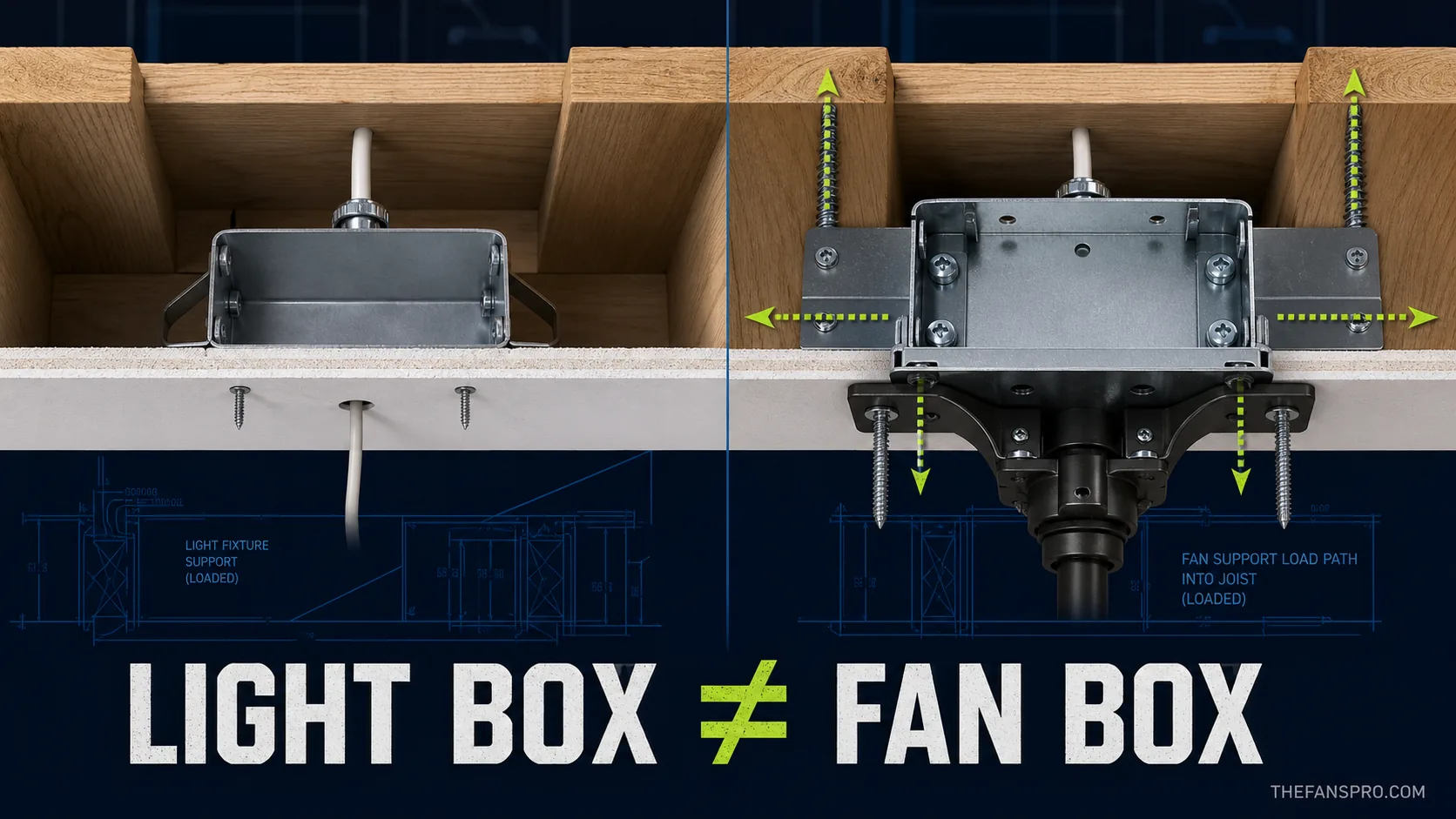
Do not hang a ceiling fan from an outlet box just because a light fixture was attached to it. A fan adds rotating, reversing, and vibration loads that a light-only box may not be listed or mounted to support. The useful question is not “does the box feel metal?” It is “is this exact box and support system identified for fan support, and is it installed the way its listing requires?”
This guide is for identifying the decision point, not authorizing a questionable installation from a photo. If the marking, support, fasteners, wiring, or structure is uncertain, stop and have a licensed electrician verify it.
As an Amazon Associate, TheFansPro earns from qualifying purchases.
The short answer
A ceiling fan should be supported by a box or listed support system intended for ceiling fans, installed into the building structure as its instructions require. A common marking is “Acceptable for Fan Support” or an explicit fan rating with a maximum fan weight. No readable marking, missing hardware, a loose box, drywall-only attachment, or an unknown brace is not a pass.
| What you find | What it means | Next move |
|---|---|---|
| Clear fan-support marking and weight rating | The box may be suitable if the exact support and installation also match its instructions | Verify fan weight, supplied fasteners, bracket fit, and structural attachment |
| Ordinary fixture box with no fan marking | Do not assume it can carry a fan | Replace or add a listed fan-support system |
| Box visibly loose or ceiling surface moves | Support is not ready for a rotating load | Stop; have the structure and box corrected |
| No access to marking or support method | Status is unknown | Do not treat unknown as approved |
| Fan heavier than the box’s fan rating | Rating mismatch | Use the fan manufacturer’s structural-support instructions |
Why a fan box is different
A ceiling light is mostly a static hanging load. A ceiling fan rotates, changes speed, may reverse direction, and can magnify a small imbalance into repeated movement. The box, brace or joist attachment, fan mounting bracket, and specified screws work as one support system.
Manufacturers make the distinction explicit. Legrand’s S109FAN is UL listed for fan and fixture support, mounts directly at a joist or cross member, uses supplied screws through the box into the joist, and publishes a 70-pound fan rating. Hubbell RACO’s 7120-1 is also identified as ceiling-fan rated and publishes a 70-pound fan limit. Those ratings apply to those exact products installed as directed—not to any box that looks similar.
How to tell whether the existing box is fan-rated
Find the exact marking
With power safely disconnected and the fixture or canopy removed according to its instructions, look inside the box for manufacturer identification, catalog number, fan-support wording, and a weight rating. Paint, plaster, and wires may obscure the stamp. Do not guess from color or material.
Identify how it reaches structure
A direct-mount box may fasten to a joist. A brace kit may span between joists. Another listed system may use a different structural method. The key is that the support follows the exact system’s instructions. Drywall and a light-duty old-work clamp are not a substitute for that load path.
Check the fan’s actual hanging weight
Use the exact model’s specification sheet or manual. Do not compare only the shipping weight. If the fan exceeds the published fan rating of the box/support system, use the structural mounting method required by the fan manufacturer.
Use the supplied fan-mounting screws
Fan-rated boxes often use different screw size, thread, length, or direct-to-joist hardware than light fixtures. Random screws that happen to fit the bracket do not preserve the listing. Follow both the box/support instructions and the fan manual.
Reject movement before installing the fan
The box and its support should not shift against the ceiling surface. A moving box, cracked surrounding material, loose brace, split framing, or elongated fastener hole needs correction before the fan is hung.
Clues are not proof
| Common clue | Why it is not enough |
|---|---|
| “It is metal.” | Some metal boxes are for fixtures only; material alone does not establish fan support. |
| “It has big screws.” | The screws, threads, bracket, box, and framing attachment must match a listed system. |
| “It is attached to wood.” | Attachment location, fastener type, edge distance, damage, and product instructions still matter. |
| “The old fixture was heavy.” | A heavy static fixture does not create the same rotating load as a fan. |
| “The bracket covers the box.” | Bracket fit does not prove the box or support is fan-rated. |
Common fan-support approaches
Direct-to-joist fan box
This system mounts at a joist or cross member and uses the manufacturer’s defined fasteners. It is useful when the fan location aligns with framing and the box’s volume is adequate for the conductors and devices involved.
Brace-and-box kit between joists
A listed brace system can span joists when the location falls between them. The brace’s rating may change with span. For example, Hubbell RACO states different fan capacities for some retrofit braces at 16-inch versus 24-inch spans. Verify the exact brace model and actual spacing.
Structure-mounted fan with a box for wiring
Heavy or specialized fans may require direct structural support independent of ordinary box capacity. Follow the fan manual. Do not assume a 70-pound fan-box rating covers every installation or dynamic condition.
Outdoor fan-support box
An exterior installation adds location and enclosure requirements. Hubbell’s PRCF57550WH, for example, is a specific outdoor fan/luminaire box with a published fan limit and NEMA 3R rating. An indoor fan-rated box is not automatically an outdoor enclosure.
Can you replace a light box without attic access?
Listed retrofit brace-and-box products exist for old-work installation through the ceiling opening, but suitability depends on joist spacing, ceiling construction, wiring access, box fill, fan weight, and the product instructions. “No attic access” does not mean “no structural support.” It means choosing an approved retrofit method for the actual framing.
Search Amazon for fan-rated ceiling box and brace systems
The search link is for comparing current products. Match any purchase to the required listing, fan rating, framing span, location, conductor capacity, and local requirements before installation.
What a fan-rated box does not solve
- a damaged joist or inadequate structure;
- a fan heavier than the support rating;
- incorrect box fill or conductor work;
- wrong damp/wet location equipment;
- insufficient blade height or side clearance;
- a slope angle outside the fan or adapter limits;
- an incompatible wall control or dimmer.
Use our downrod length chart for finished blade height and our ceiling-fan size chart for room coverage. If the existing fan rattles or the canopy moves, use the ceiling-fan noise diagnostic guide after that article is public.
When to call an electrician
Use a licensed electrician when the box marking or support cannot be verified, wiring must be moved or extended, the circuit or grounding is uncertain, the fan is unusually heavy, the framing is damaged, the location is outdoor/wet, or the work requires opening finished surfaces. Also stop if you find overheated insulation, loose conductors, arcing evidence, or a box that moves.
Bottom line
A light box is not a fan box unless its exact listing says it is. Look for fan-support identification and a weight rating, then verify the structural attachment, supplied fasteners, fan weight, location, and manual. When any part of that chain is unknown, the correct answer is not “probably.” It is verify or replace.
