
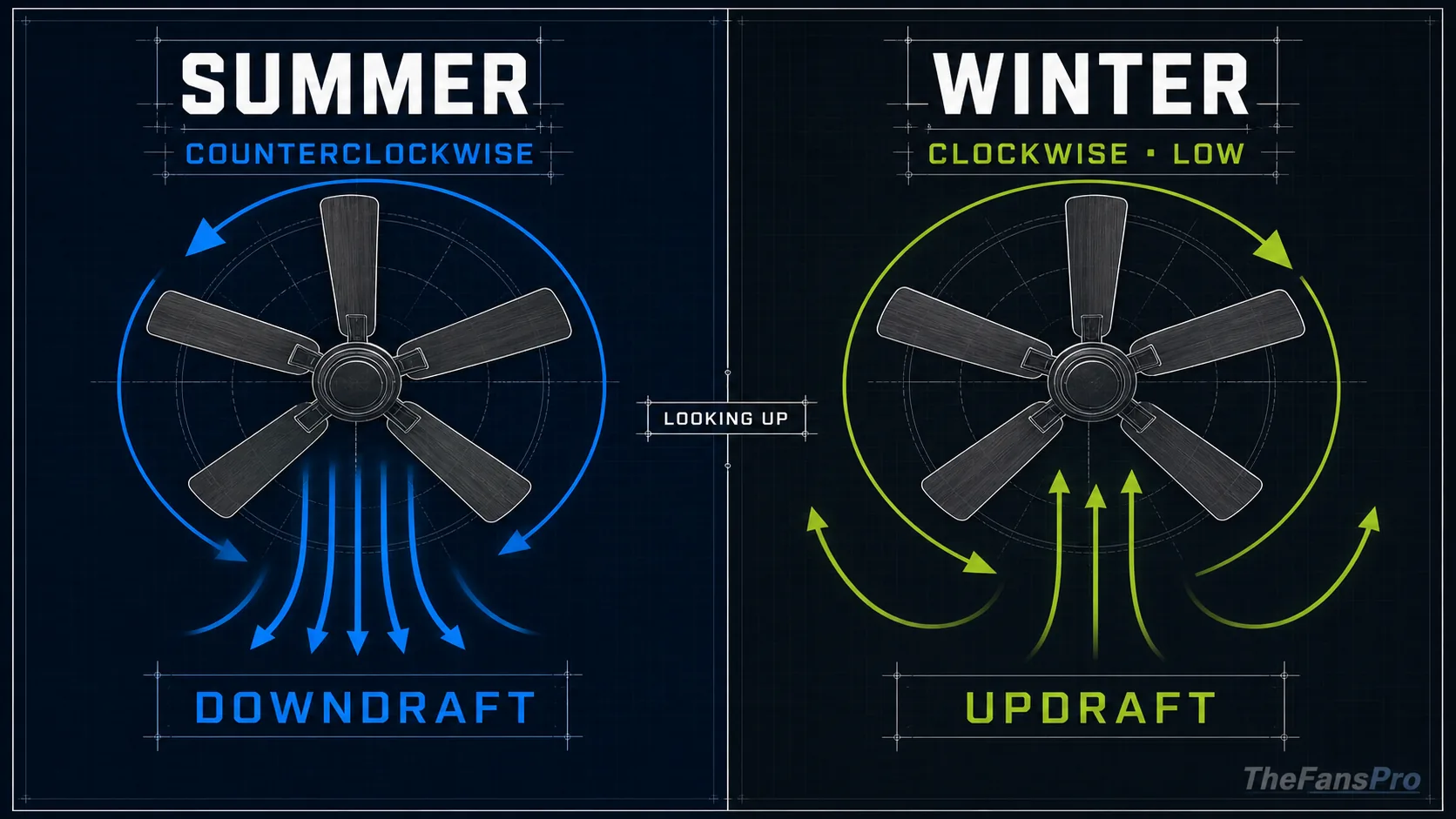
Looking up at the fan from below: use counterclockwise in summer and clockwise on low in winter. Counterclockwise creates the direct downdraft that makes people feel cooler. Clockwise on low creates a gentle updraft that can recirculate warm air collected near the ceiling.
If the direction is correct but airflow misses your seating area, check fan placement and blade height in large rooms.
Ceiling fan direction: the quick chart
| Season | Direction while looking up | Speed | Air movement |
|---|---|---|---|
| Summer | Counterclockwise | Comfortable medium or high setting | Downdraft; you should feel a breeze below the fan |
| Winter | Clockwise | Low | Gentle updraft; recirculates warm ceiling air without a strong breeze |
Summer direction: counterclockwise
Set the fan to rotate counterclockwise when you look up from underneath it. With a normally installed fan, this pushes air downward into the occupied part of the room. Moving air helps perspiration evaporate and makes your skin feel cooler even though the fan does not reduce the room’s actual temperature.
Use the lowest speed that creates the breeze you want. Medium or high often feels best during hot weather, but comfort depends on fan size, mounting height, room layout, and where you sit. Turn the fan off when the room is empty; it cools people rather than storing “coolness” in the room.
Winter direction: clockwise on low
Set the fan to rotate clockwise while looking up and run it slowly. The goal is a gentle updraft in the center that moves warmer ceiling air outward and down the walls without creating the direct cooling breeze used in summer.
This is most useful in a heated room where warm air collects well above the occupied level, such as a great room, loft, tall workshop, or vaulted space. It may provide little benefit in a short room with minimal temperature difference between floor and ceiling. If the winter setting creates a noticeable cold breeze where people sit, reduce the speed or turn the fan off.
How to tell which way the fan is spinning
- Stand beneath the fan and look upward.
- Follow one blade as it passes the front edge of the circle.
- If it travels from right to left across that front edge, the rotation is counterclockwise.
- If it travels from left to right, the rotation is clockwise.
If the rotation is hard to follow, use the airflow check. A pronounced breeze directly underneath indicates downdraft and the usual summer setting. Little direct breeze on low indicates the winter updraft setting.
How to reverse a ceiling fan safely
Stop the fan completely before changing direction. Do not operate a physical reversing switch while the blades are moving.
Fan with a slide switch
Turn the fan off and wait for the blades to stop. Find the small reversing switch on the motor housing, move it fully to the opposite position, then restart the fan. Switch orientation varies by model, so confirm the result from the direction or airflow rather than assuming left, right, up, or down always means the same season.
Fan with a remote
Many remote-controlled DC fans reverse with a dedicated direction button. The icon often uses two curved arrows. Some models require the blades to stop first; others manage the stop-and-reverse sequence electronically. Follow the exact manual.
Smart ceiling fan
Look for direction or reverse in the manufacturer’s app. Voice-platform support varies: an app may expose speed and light controls without exposing direction. Our current smart ceiling-fan guide covers fans with native and bridged controls.
No visible switch or button
Do not force a housing control or use a generic remote at random. Find the exact model number and manual. Some fans reverse only through a paired remote or app, while a non-reversible model has no seasonal direction control.
Room-by-room starting points
| Room | Warm weather | Cold weather |
|---|---|---|
| Bedroom | Counterclockwise at the quietest comfortable speed | Clockwise on low if recirculation helps; otherwise off |
| Standard-height living room | Counterclockwise while occupied | Clockwise on low only if the room has noticeable temperature stratification |
| Great room or vaulted ceiling | Counterclockwise for occupied-zone breeze | Clockwise on low to test whether destratification improves comfort |
| Heated garage or workshop | Counterclockwise toward the work zone | Clockwise on low when heat collects near a tall ceiling |
| Unheated covered patio | Counterclockwise for a direct breeze | Usually off because there is no heated ceiling layer to recover |
For tall rooms, our downrod length chart helps determine finished blade height. A dedicated large-room and high-ceiling guide is scheduled for September 30; its inbound links will be added only after the destination is public.
Common mistakes
- Judging direction from above: seasonal guidance is normally stated while looking up from below.
- Running winter mode too fast: a strong breeze can make occupants feel colder.
- Changing a physical switch while moving: stop the fan first.
- Assuming the fan changes room temperature: summer comfort comes from air movement across people.
- Assuming every remote reverses every fan: transmitter, receiver, and control functions must match the exact model.
Frequently asked questions
Which way should a ceiling fan spin in summer?
Counterclockwise while looking up from below. That normally creates the downdraft and direct breeze used for summer comfort.
Which way should a ceiling fan spin in winter?
Clockwise on low while looking up from below. The gentle updraft can recirculate warm air near the ceiling without a strong cooling breeze.
How can I check summer direction quickly?
Stand safely under the fan. A clear downward breeze indicates the usual counterclockwise summer setting.
Do all ceiling fans reverse?
No. Many use a housing switch, remote, or app, but some models are not reversible. Check the exact manual.
Should the fan run when nobody is in the room?
Usually not for summer comfort. A fan makes occupants feel cooler through moving air; it does not continue cooling an empty room.
