
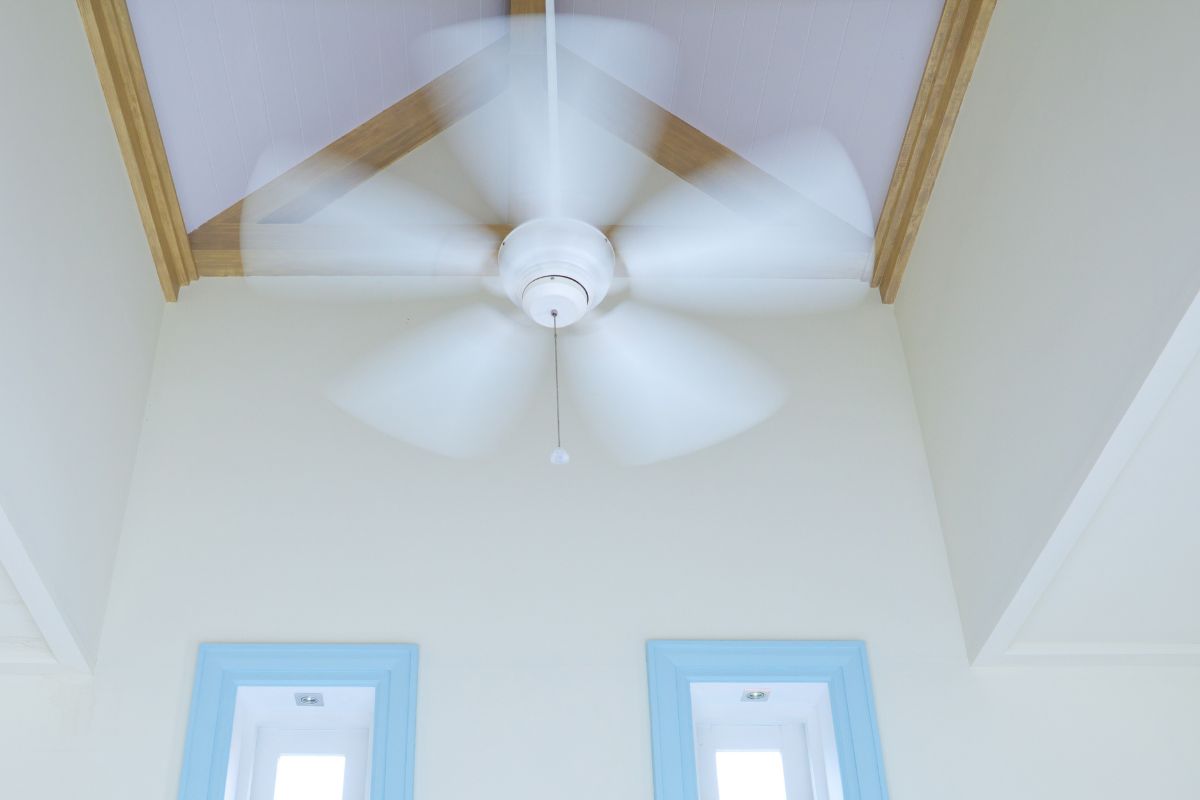
Quick answer: restore the fan’s intended settings; do not try to exceed its rated speed. Start with its manual and controls. A fan that suddenly runs slowly may need service rather than a speed upgrade.
Check the controls before ordering parts
For Hunter pull-chain fans with an accessory remote, Hunter says to set the pull-chain speed to high so the remote can control it. Check remote batteries and use the exact model’s pairing instructions. A reverse switch should be fully engaged; turn the fan off and wait for the blades to stop before changing it.
A standard light dimmer is not a fan-speed control. Hunter lists incompatible controls among possible causes of trouble. If the fan has a DC motor or an integrated receiver, use only the controls approved for that model.
When to stop and get service
Stop using a fan that smells burnt, crackles, or has damaged wiring. Turn off power at the breaker before any work that opens the fan or canopy. Have an electrician or the manufacturer diagnose internal components; a slow speed alone does not identify a bad capacitor.
Use the model number to choose the next step
Find your manual through our fan manual library. For a new hum, click or rattle, use the ceiling fan noise diagnostic guide. Harbor Breeze owners can use the parts and remote identification guide after confirming the failed part and exact match.
Do not add oil unless your model’s manual specifies an oiling procedure. Do not bypass controls, change blade pitch, or substitute an unapproved capacitor to force more speed. If the fan works normally but the room still feels poorly covered, check fan size and room dimensions and seasonal fan direction before replacing it.
Spec-verified: control checks based on Hunter’s troubleshooting instructions and Hunter’s humming and electrical warning guidance, checked October 2, 2026. Other brands require their own model instructions.
